
In this post, Startup Foundation grantee and Rotomate co-founder Jesse Miettinen shares five invaluable learnings on how to build an AI startup from scratch.
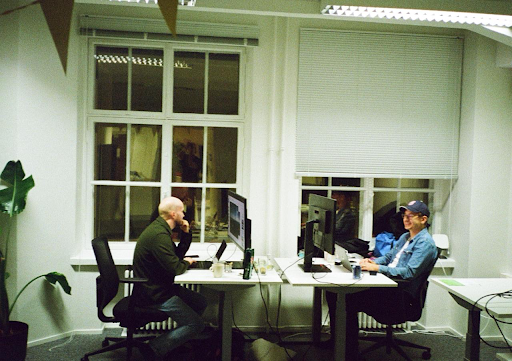
Caught off-guard while working late hours (left: Mikko Kuusisto, right Jesse). Credit: Markku Leppälä.
The story of Rotomate started in the summer of 2023, when Mikko Kuusisto and I first started our stealthy market research towards AI solutions in industrial operations. This effort led to Rotomate being founded by Spring 2024, with a plan to commercialise the latest deep learning-based algorithms for the industrial sector.
What we found compelling was working with AI and data-intensive products that serve engineers operating large machines. The machines add a nice, real-world flavour to the AI software development.
Our backgrounds were also a match for this endeavour. Mikko had experience in building data products at Swappie, and I was just about to finish a PhD related to industrial AI.
Fast forward to January 2026, we are a team of nine people working closely with numerous engaged customers. Our focus is on developing agentic workflows that serve industrial engineers in their day-to-day operations. For now, we’ve been calling our product “the AI Engineer”.
Founding an AI company for industrial clients is super interesting. Many of the learnings we have had along the way are very specific to this field and the technologies used. However, many of the best learnings have had something to do with fundamentals: how to be smart when building your product and how to survive the early days. Here are five useful lessons to take away from Rotomate’s story.
Learning #1: Sell immediately
Optimally, start selling before you found the company. You don’t need to set up a company and pay for a bank account before a customer asks for your bank account details.
The first sales are super important. They provide the founders with an unimaginable confidence boost and much-needed external validation for the company. Moreover, you learn how to dance the ABC-dance (always be closing) in your target market. In addition, you get the first look at the paperwork, etc., needed between the handshake and the signed contract. Finally, I would not worry too much if the first customers do not fit your ideal customer profile. After all, the ideal customer profile is prone to change before you reach product-market fit.
For us, it took about 6 months (on weekends, evenings, and vacation days) of market research and tons of closing attempts to actually close our first sales. Afterwards, our product vision has changed drastically along with our ideal customer profile.
Learning #2: Use discovery mode
If you are not satisfied with your sales performance, discover improvements to your offering. While in discovery mode, define simple objectives and key results (OKRs) and measure your performance against them.
We went on to full discovery mode twice during the first year of Rotomate. Each time, this phase completely dominated our focus and our calendars. Our objective was to determine whether we can build the new best solution and whether we should build it. Our questionnaire templates covered everything related to current market solutions, customer behavior, pricing, and overall market value. We measured our performance by the number of emails sent, cold calls made, and meetings held. The ultimate aim was to have 20+ meetings with different companies during each discovery mode.
The positive outcomes from the discovery modes were numerous. First off, a couple of the meetings converted to first sales later on. Second, we learned how to build a differentiating product. Third and most importantly, we gained up-to-date insights into the daily behaviour of our potential customers. Ambitious products change the way their customers behave. Therefore, understanding the target customer's current behaviour is mandatory before building an ambitious product.
Learning #3: Design the meeting dynamics with potential customers
Before product-market fit, every single meeting with a potential customer is an opportunity to learn from someone who knows what you need to know. Make sure not to leave even the smallest amount of information on the table. Pre-write interview scripts with a few different sets of questions for different profiles: one for the user, another one for their manager, and yet another one for the director / CxO level. Make sure to introduce yourselves first. It feels natural to start asking questions right after the intros of the potential customer. The last item in the agenda is always your product vision. If you present your product vision earlier, you risk getting roasted for the rest of the meeting.
We used three different interview scripts for the target profiles: engineers, factory managers, and senior management. Our questions ranged from practical to social topics, such as which sensors and software are used, who was responsible for what, and how mistakes affect trust.
Following the scripts helped in three important ways. First, the scripts made it easier to spot repeating answers. Second, we gained multiple perspectives on the same problems. The engineers and managers understood the pain points intimately, while the senior managers knew the economical effect. Third, by testing the product vision at the end, we were able to actively engage customers in the discussion. This was especially important in the very early days, when the product vision was still immature.
Learning #4: Low-burn until slide-market-fit
While going through the sales and discovery cycles, you might want to save your cash. It is nicer to have more cash when you are confident in the product you are about to start building. After determining what the market wants, the safest approach is to build the product on slides. At this point, present the slides to the people you’ve met during the sales/discovery mode meetings. If they say yay, make a big launch of the product vision. If more people say yay after the big launch, it is time to start increasing the burn.
We kept our burn super low until we had the product on slides and some proof-of-concept software. Then we presented our product vision, along with some early demo examples, at an event attended by around 150 people from potential customer companies. Soon after, we were fully sold out and in a hurry to deliver our promises to excited customers. It was time to start hiring.
Learning #5: Fundraising
Make sure you know why you need the money. If VC’s say no, don’t worry. During the search for product-market fit, small funding is a fortune, since constraints increase focus and performance. Funding follows the revenue, not the other way around, especially if you are a first-time founder without the magical “stardust”.
Thanks for reading, and best of luck if you are also building a company! Also, thank you, Startup Foundation, for helping out during the super low-burn period.
– Jesse Miettinen
